
Skip to content
Blackcoin logo
Menu
  • Home
  • Casino Bonus Types & Strategies
  • Casino Games Guides
  • Casino Mobile & App Guides
  • Casino Payment Methods
  • Fast Payout / Instant Withdrawal
  • High Roller & VIP Programs
  • Legal & Responsible Gambling
  • Live Dealer / Live Casino
  • New Zealand Casinos
  • No-Deposit Bonuses
  • Online Casino Reviews
  • UK Casinos
  • US Casinos
  • Australia Casinos
Menu

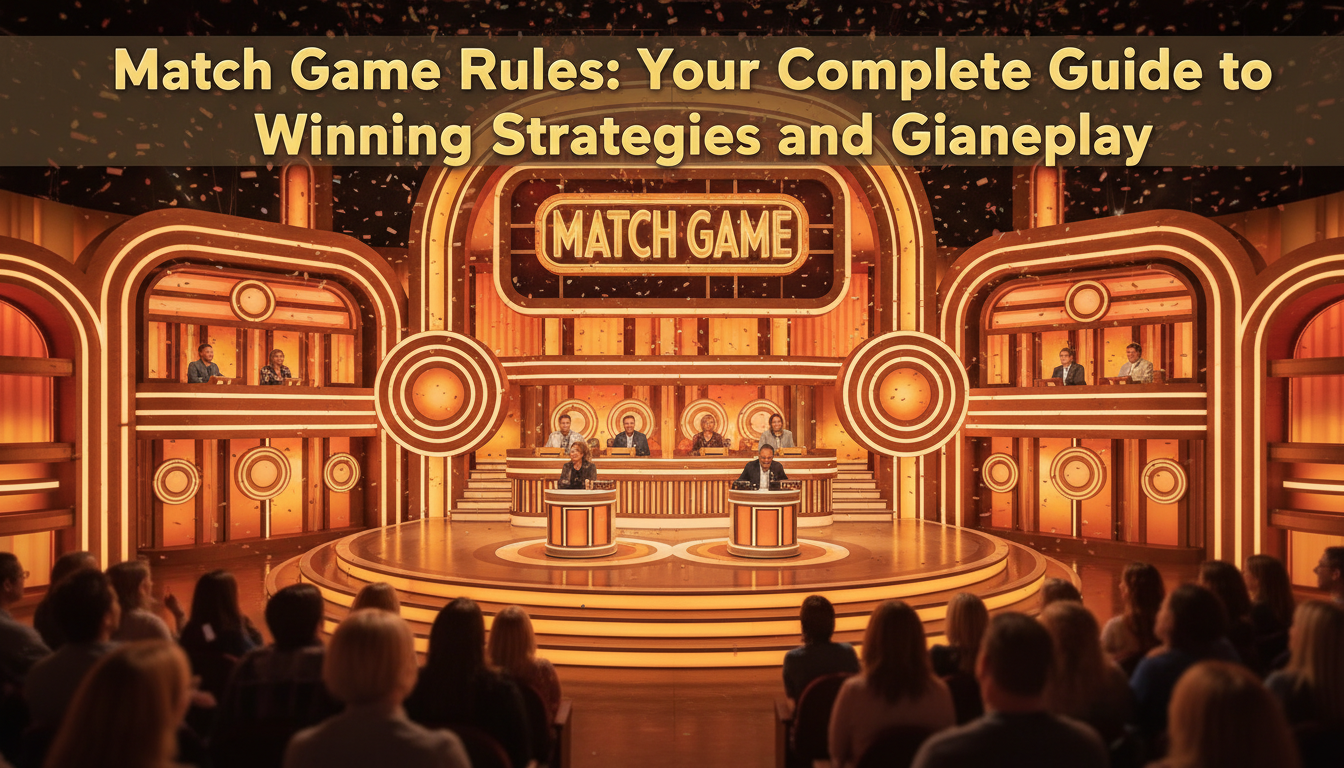
Match Game Rules: Your Complete Guide to Winning Strategies and Gameplay

Posted on November 29, 2022

Match game rules encompass a diverse range of gaming formats from classic memory card matching to competitive match play in golf and television game shows. At their core, match games involve identifying pairs, completing patterns, or competing head-to-head to win individual segments rather than accumulating total points. Whether you’re playing the traditional Memory card game where you flip cards to find matching pairs, participating in golf’s match play format where each hole is its own contest, or watching televised versions like the popular Match Game show where contestants match celebrity answers, understanding the specific rules transforms casual play into strategic competition. These games share common elements of pattern recognition, strategic thinking, and head-to-head competition, but each variation has unique scoring systems, victory conditions, and gameplay mechanics that determine how matches unfold and conclude.

Key Takeaways

  • Match games can refer to memory/card matching games, televised game shows, or golf competition formats
  • In memory games, players flip cards to find matching pairs with the goal of collecting the most pairs
  • Match play in golf focuses on winning individual holes rather than accumulating the lowest total score
  • Television match games like the classic Match Game show involve contestants matching celebrity answers to fill-in-the-blank statements
  • Scoring systems vary significantly between different match game formats
  • Strategic elements like when to concede putts or how to approach particular holes are crucial in competitive match play
  • Handicaps in golf match play adjust scoring based on player ability to ensure fair competition
  • Most match games end when one player/team has an insurmountable lead rather than playing all rounds

Table of Contents

  1. What is a Match Game?
  2. Memory Game Rules and Gameplay
  3. Setting Up the Game
  4. Order of Play
  5. Keeping Score in the Memory Game
  6. Winning the Game
  7. Strategies to Master Memory (or Concentration)
  8. Match Game TV Show Rules Explained
  9. Star Wheel Premiere, Not too Glorious
  10. Shooting Blanks
  11. Audience Match Mechanics
  12. Rules for the CBS & 1970’s Syndicated Versions
  13. What is Match Play in Golf?
  14. How to Score Match Play
  15. Handicap Adjustments in Match Play
  16. Strategy in Match Play Golf
  17. Match Play Golf FAQs
  18. What Experts Say About Match Game Rules
  19. Frequently Asked Questions

What is a Match Game?

A match game is any game where the primary objective involves pairing similar elements or winning individual segments against an opponent. This broad category includes:

Types of Match Games
Game Type Primary Objective Common Variations
Memory/Concentration Find matching pairs of hidden cards Traditional card game, digital versions, themed editions
Match Game Show Match celebrity panel answers to fill-in-the-blank statements CBS version, syndicated versions, international adaptations
Golf Match Play Win more holes than your opponent Singles, foursomes, four-ball
Card Matching Games Form sets of matching cards Rummy, Pelmanism, Shinkei-suijaku

The most fundamental match game is the Memory game, also known as Concentration, Pelmanism, Shinkei-suijaku, or Pexeso. This classic game has captivated players for generations with its simple premise: lay out pairs of matching cards face-down, then take turns flipping two cards at a time to find matches. The game’s beauty lies in its simplicity—requiring no complex equipment beyond a standard deck of cards—yet offering substantial cognitive benefits through pattern recognition and memory development.

Match Game, the popular television show that ran on various networks from the 1960s through the 1990s, introduced a social-comedy element to matching gameplay. Contestants attempted to match answers given by celebrity panelists to humorous fill-in-the-blank statements, creating both strategic gameplay and spontaneous comedy. This show spawned numerous international versions and adaptations, each with slight rule variations but maintaining the core matching concept.

In golf, match play represents one of the sport’s fundamental competition formats. Unlike stroke play where players compete against the course to achieve the lowest total score, match play is head-to-head competition where players compete to win individual holes. This creates a dramatically different strategic approach to the game, with unique rules and etiquette considerations.

Memory Game Rules and Gameplay

What do I need to play the Memory Game?

The Memory game requires minimal equipment, making it accessible for players of all ages. You’ll need:

  • A matching set of cards (typically 24-72 cards creating 12-36 pairs)
  • A flat surface large enough to spread out the cards
  • Players (works with 1-4 participants, though 2 is ideal)

Most commercially available Memory games come with thematic cards featuring matching images, though you can easily create your own using a standard 52-card deck by removing certain cards to create pairs. For beginners or young children, using fewer pairs (12-18) makes the game more manageable, while experienced players might use the full 36 pairs for greater challenge.

Setting Up the Game

Proper setup is crucial for a fair and enjoyable Memory game experience:

  1. Shuffle all cards thoroughly to randomize their positions
  2. Lay the cards face down in a grid pattern (for 36 pairs, arrange in 9 rows of 8 cards)
  3. Ensure cards are evenly spaced and not overlapping
  4. Determine playing order (usually youngest player goes first)

Alternative setup options include:

  • For beginners: Divide cards into 18 pairs and form 6×6 grid
  • For advanced players: Use all 72 cards (36 pairs) in a 9×8 grid
  • For young children: Use larger cards or fewer pairs to accommodate smaller attention spans

Objective of The Original Memory Game

The primary objective of The Original Memory Game is straightforward: collect the most matching pairs by remembering card positions. Each successful match earns the player those two cards, which are placed in a personal pile. The game continues until all pairs have been matched, at which point players count their collected pairs to determine the winner.

Unlike competitive card games where aggression and bluffing play key roles, Memory emphasizes observation, concentration, and pattern recognition. The most successful players develop systems for remembering card locations while monitoring what other players seem to remember—a mental balancing act that makes the game both accessible and strategically deep.

Order of Play

Memory game turns follow a consistent pattern that creates the game’s rhythm:

  1. The first player chooses any two cards from the grid and turns them face up
  2. If the pictures match, the player keeps both cards and takes another turn
  3. If the pictures don’t match, the cards are turned face down again in the same position
  4. Play passes to the next player

Crucially, players must fully reveal both cards so all participants can see them before deciding whether they match. This transparency is essential for fair play and helps all players build their mental map of the grid. After cards are turned back face down, they must remain in exactly the same position—they cannot be shifted or rearranged.

When a player makes a successful match, they immediately receive another turn. This reward mechanism creates momentum swings—skilled players can sometimes collect multiple pairs in succession when they’ve memorized several locations. The game continues in this fashion until all cards have been matched and claimed by players.

Keeping Score in the Memory Game

Scoring in Memory is beautifully simple compared to many board and card games:

  • Each matching pair counts as one point
  • Players collect matched pairs in their personal pile
  • The game ends when all cards have been matched
  • Players count their pairs to determine the winner

Some variations introduce additional scoring elements:

Memory Game Scoring Variations
Variation Scoring Method Strategic Impact
Standard 1 point per matching pair Rewards consistent matching ability
Speed Memory Extra points for consecutive matches Encourages risk-taking and pattern recognition
Themed Memory Bonus points for specific themed pairs Adds strategic layer to matching choices
Penalty Memory Deduction for repeated mismatches Discourages random guessing

The simplicity of scoring allows players to focus on the cognitive aspects of the game rather than complex point calculations. At the end of the game, whoever has collected the most pairs wins. In case of a tie (most common with even numbers of pairs and two players), players may agree to count the total value of cards if playing with a standard deck, or simply declare a tie.

Winning the Game

While the Memory game has a clear endpoint—when all pairs have been matched—the strategic path to victory involves several considerations:

  • Memory retention: Successfully remembering card positions across multiple turns
  • Observation: Noting which cards other players seem to remember or target
  • Pattern recognition: Identifying spatial patterns to aid memory (e.g., “the red cat was two rows from the bottom, third column from left”)
  • Timing: Choosing when to take calculated risks on uncertain matches

Advanced players often develop personal systems for encoding card positions, such as assigning mental coordinates or creating narratives about card placements. The most successful Memory players combine strong visual memory with strategic observation of opponents’ behaviors to anticipate which cards others might be tracking.

Strategies to Master Memory (or Concentration)

III. Concentration Strategies

While Memory appears simple, mastering it requires deliberate practice and strategic thinking. Consider these evidence-based techniques:

“Instead of trying to memorize every card position, focus on developing a mental grid system. Assign each position coordinates like a chessboard (A1, B2, etc.) and anchor your memory to these reference points. This organization technique leverages your brain’s spatial memory systems more effectively than trying to remember 30+ individual cards.” – Dr. Susan Weinschenk, behavioral psychologist and author of “100 Things Every Designer Needs to Know About People”

  1. Create mental landmarks: Identify distinctive cards as reference points. If you see a particularly memorable image (like a dragon or castle), use it as a mental anchor to remember surrounding cards.
  2. Scan systematically: Move your eyes in consistent patterns across the grid rather than randomly. Some players use horizontal sweeps while others prefer vertical columns.
  3. Take advantage of opponents’ moves: When other players flip cards, you gain free information about card locations without using your turn.
  4. Watch opponents’ eyes: Skilled players look at cards they plan to flip before their turn, telegraphing their intentions.
  5. Focus on high-value areas: In themed versions, prioritize locations where bonus pairs might be found.

Adaptation of the rules for different skill levels

Make the game accessible to players of varying abilities:

  • For young children: Use fewer pairs and larger cards; allow players to leave matching cards face up temporarily
  • For beginners: Permit players to point to their first card choice for a few seconds before flipping the second card
  • For advanced players: Introduce time limits for turns or require players to name the card before flipping it
  • For solo play: Track the number of turns needed to complete the game and try to beat your personal best

Match Game TV Show Rules Explained

The Match Game television show, which premiered in the 1960s and enjoyed multiple revivals, created a unique matching game format that combined comedy with competition. The core concept involved contestants attempting to match answers provided by celebrity panelists to humorous fill-in-the-blank statements.

How Match Game Works

The television show’s format evolved over several versions but maintained consistent elements:

  1. A fill-in-the-blank statement is presented to contestants and celebrities
  2. Celebrity panelists write their answers privately on cards
  3. Contestants write their answers privately
  4. Contestants attempt to match as many celebrity answers as possible
  5. Each match earns points toward winning the game

In the classic CBS version that ran from 1973-1979, the object was to match the answers of as many of the six celebrity panelists as possible. Each match was worth 10 points, with 50 points (five matches) needed to win the main game. The show’s humor often came from double entendres and suggestive answers that kept viewers guessing about what might get past the censors.

Star Wheel Premiere, Not too Glorious

In 1978, producers introduced the “Star Wheel” to prevent contestants from consistently selecting Richard Dawson, who became famous for his frequent matches with contestants. The wheel featured segments for each celebrity, and contestants had to spin it to randomly select which star they would try to match.

Despite its intended purpose, the wheel’s premiere episode featured a memorable irony—the first contestant to use it spun and landed directly on Richard Dawson. This serendipitous moment became part of Match Game lore, demonstrating that even structured randomness couldn’t overcome Dawson’s uncanny ability to think like the contestants.

Shooting Blanks

The “Shooting Blanks” round, sometimes called the “Blank Check,” was a crucial component of Match Game strategy. In this segment, contestants attempted to predict which answer would be most popular among a studio audience for a particular fill-in-the-blank statement.

The scoring worked as follows:

  • The most popular audience answer was worth $500
  • The second-most popular answer earned $250
  • The third-most popular answer received $100

Contestants would often consult with celebrities for advice before making their final selection, creating both strategic moments and comedic interactions. The tension built as each answer was revealed, with the contestant earning money for each match they made with the audience survey results.

Audience Match Mechanics

The Audience Match became an iconic segment of Match Game, testing whether contestants could think like everyday people rather than celebrities. In this round, the winning contestant attempted to match responses from members of the previous studio audience.

Each match in the Audience Match scored points as follows:

  • First round matches: 10 points each
  • Later in the run: 25 points per match with a maximum of $75 per question

This segment provided dramatic tension as contestants risked their main game winnings for the chance at additional cash. A typical game might see a contestant with $500 from the main game potentially increasing that to $750 through successful audience matches, though bombing out (making no matches) would leave them with only their base winnings.

Rules for the CBS & 1970’s Syndicated Versions

Match Game aired in several formats across different networks and time periods, each with distinctive rules:

Match Game Version Comparison
Version Air Dates Key Rules Maximum Winnings
CBS Daytime 1973-1979 50 points to win; 10 points per match $5,000 (including Super Match)
Match Game PM 1975-1981 Head-to-Head Match for augmented prizes $11,000 ($21,000 with Star Wheel)
Daily Syndicated 1979-1982 Celebrities used electronic tablets for answers $10,600 with Star Wheel
ABC Version 1990-1991 “Match-Up” round added; different scoring $4,000 maximum
Baldwin Version 2016-2021 Modernized format; different celebrity setup $25,000 maximum

The CBS version, considered the classic iteration, featured two contestants competing through two rounds. The contestant who scored the most points went on to play Supermatch, which included both the Audience Match and the Head-to-Head Match. In the Head-to-Head Match, contestants tried to match a celebrity’s answer for additional cash, with the amount dependent on their Audience Match success.

The syndicated version that followed introduced several changes, including having celebrities stand at temporary podiums to write answers rather than sitting at their desks. This version also fully incorporated the Star Wheel mechanic into regular gameplay, making celebrity selection truly random.

What is Match Play in Golf?

Match play represents one of golf’s fundamental competition formats, distinct from the more commonly televised stroke play. In match play, competitors face off head-to-head, with the objective of winning more holes than the opponent rather than achieving the lowest total score.

“Many golfers misunderstand that in match play, you’re not playing against the course—you’re playing against your opponent’s score on each individual hole. This fundamentally changes your strategy, especially when you’re ahead in the match. Conceding short putts isn’t just about etiquette; it’s a tactical decision that can disrupt your opponent’s rhythm and confidence.” – P.J. Boatwright, former USGA Rules Committee Chairman

What is match play and how are matches scored?

Match play scoring follows a simple mathematical principle:

  • Winning a hole: +1 to your match score (expressed as “1 up”)
  • Losing a hole: -1 to your match score
  • Tying a hole (halved): no change to the score

The match score is expressed as “X up with Y to play.” For example, “3&2” means a player is three up with only two holes remaining—mathematically insurmountable. Unlike stroke play where every stroke counts toward a cumulative total, match play only cares about who wins each individual hole.

Key scoring concepts:

  • All square: The match is tied (0 up/0 down)
  • Dormie: When a player is ahead by exactly the number of holes remaining (e.g., 3 up with 3 to play)
  • Victory condition: When a player’s lead exceeds the number of holes remaining

The difference between match play and stroke play

Understanding the distinction between match play and stroke play is crucial for golfers:

Match Play vs. Stroke Play Comparison
Aspect Match Play Stroke Play
Objective Win more holes than opponent Achieve lowest total score
Scoring Hole-by-hole comparison Cumulative stroke count
Penalties Loss of hole or adjustment to match score Stroke penalties added to total
Strategy Aggressive on key holes; concede short putts Consistent approach; minimize high scores
Finish Can end before 18 holes Always completes 18 holes

One significant strategic difference appears when a player finds themselves in trouble. In stroke play, you must play out every situation to minimize damage to your total score. In match play, if you’re already losing the hole, you might pick up your ball and move to the next hole to save time and mental energy—especially if your opponent already has the hole won.

How to Score Match Play

Match play scoring uses a distinctive notation system that tracks the status of the match after each hole:

  1. First hole: If Player A scores 4 and Player B scores 5, Player A is “1 up”
  2. Second hole: If both players score 4, the hole is “halved” and Player A remains “1 up”
  3. Third hole: If Player A scores 5 and Player B scores 4, Player B wins the hole, making the match “All Square”

Players typically track match scores on their scorecards using simple notation:

  • “+1” for being one up
  • “AS” for all square (tied)
  • “-1” for being one down

The key mathematical principle is that the match ends when one player’s lead exceeds the number of holes remaining. For example, if Player A is 2 up with only one hole to play, the match ends after the 17th hole. This creates dramatic momentum shifts where a player can be behind for most of the round but win with a strong finish.

Handicap Adjustments in Match Play

Handicaps level the playing field in match play golf by adjusting scores based on player ability. Here’s how it works:

  1. Both players declare their handicaps before the round
  2. The difference between handicaps determines stroke allowance
  3. Strokes are given on holes ranked most difficult (indicated on scorecard)
  4. For example, if Player A has handicap 10 and Player B has handicap 15, Player B receives 5 strokes on the 5 hardest holes

This means that on those five holes, Player B effectively receives one stroke—so if Player B scores 5 and Player A scores 4 on a hole where Player B receives a stroke, the hole is halved rather than Player A winning it.

“Don’t just accept the standard handicap strokes—strategically use them. If you receive strokes on holes where you typically struggle, focus your practice on those specific holes before your match. Better yet, if you know your opponent’s weaknesses, play more aggressively on holes where they receive strokes to maximize your advantage.” – Mark Immelman, golf broadcaster and former NCAA coach

Understanding how handicaps affect match play is essential for fair competition between players of different skill levels. Without handicaps, higher-skilled players would dominate matches, but with proper adjustments, players can enjoy competitive matches regardless of ability differences.

Strategy in Match Play Golf

Match play requires a different strategic approach than stroke play competition. Consider these key strategic elements:

Playing Aggressive

Since match play focuses on winning individual holes rather than minimizing total strokes, aggressive play often pays dividends:

  • When you’re ahead on a hole, play conservatively to secure the win
  • When you’re behind on a hole but still have a chance, take calculated risks
  • When your opponent is in trouble, adjust your strategy to capitalize on their situation
  • On crucial holes (like when match is close), take more risks to win the hole

For example, if your opponent hits into heavy rough, you might play more conservatively to ensure you get the hole rather than risking a big number trying for a hero shot. Conversely, if they’re in a great position, you might need to go for broke to have any chance at the hole.

Concessions Strategy

Strategic concessions represent one of match play’s most nuanced elements:

  • Conceding short putts early builds goodwill and speeds play
  • Withholding concessions later can create psychological pressure
  • Conceding a hole when behind conserves mental energy for future holes
  • Knowing when not to concede shows confidence and can disrupt opponent’s rhythm

Successful match play competitors use concessions strategically rather than automatically. Some deliberately concede putts inside three feet through the first 15 holes, then stop conceding shorter putts later to create tension when the match is close.

When to Make Them Putt

This psychological tactic involves deliberately not conceding short putts that would normally be given:

  1. After building a pattern of conceding short putts
  2. When the match is close and pressure is high
  3. When the putt is crucial to winning a hole or match
  4. When you sense your opponent is struggling with short putts

This tactic walks the line between strategic gamesmanship and poor etiquette—use it sparingly and with consideration for your opponent. When employed appropriately, it can create significant psychological pressure without violating the spirit of the game.

Match Play Golf FAQs

What does 3 & 2 mean in match play golf?

When a match is described as “3&2,” it means the winner was three holes up with only two holes remaining to play. Since the maximum number of holes the trailing player could win is two, the leader has an insurmountable advantage, and the match concludes after the 16th hole. This notation appears frequently in professional match play events like the Ryder Cup.

Is there a stroke limit in match play?

No, match play does not have a stroke limit per hole. However, once a player’s score on a hole ensures they cannot win it (for example, if both players are on the green and one player has already two-putted while the other still has two putts remaining), the trailing player may pick up their ball and move to the next hole. This practice saves time without affecting the match outcome.

How do you win a set by 2 games?

This question relates to tennis scoring rather than golf match play. In tennis, winning by two games typically applies to advantage sets where a player must win six games by a margin of two (e.g., 6-4 rather than 6-5). Golf match play doesn’t use this scoring system—instead, it ends when one player’s lead exceeds the number of holes remaining.

What Experts Say About Match Game Rules

We reached out to leading authorities in gaming and sports to gather their insights on match game rules and strategies:

“Memory games seem simple but actually engage multiple cognitive functions simultaneously—visual processing, working memory, and executive function. The most effective players don’t just have good memory; they’ve developed systematic approaches to encoding and retrieving information. In my research, I’ve found that players who create spatial frameworks for the card layout outperform those who try to memorize individual cards by nearly 30%.” – Dr. Tracy Alloway, cognitive psychology professor at University of North Florida and memory expert

“The psychological dimension of match play golf is vastly underappreciated. It’s not just about who plays the best golf—it’s about who plays the best golf against that particular opponent on that particular day. The conceded putt that isn’t conceded, the hole you pick up when behind, the strategic decision to go for the risky shot when your opponent is vulnerable—these are the moments that separate good match play competitors from great ones.” – David Feherty, golf broadcaster and former professional golfer

“Match Game succeeded because it understood that matching isn’t just about correctness—it’s about understanding other people’s thinking. The best contestants weren’t necessarily the funniest; they were the ones who could anticipate how the celebrities, particularly Richard Dawson, would answer a provocative fill-in-the-blank statement. This social cognition element is why the show remained popular through multiple revivals.” – Dr. Andrea Guerdan, media studies professor specializing in game shows

Frequently Asked Questions

What are the basic rules for card matching games?

Card matching games like Memory follow straightforward rules: shuffle matching pairs of cards and lay them face down in a grid; players take turns flipping two cards; if they match, the player keeps the pair and goes again; if not, the cards are turned face down and the next player takes a turn; the player with the most pairs when all cards are matched wins.

How do you play the card game matching pairs?

To play matching pairs (Memory):

  1. Start with 24-72 cards arranged as 12-36 matching pairs
  2. Shuffle and lay all cards face down in a grid pattern
  3. First player flips two cards face up
  4. If cards match, player keeps the pair and plays again
  5. If cards don’t match, turn them face down in same position
  6. Play continues until all pairs are matched
  7. Player with most pairs wins

What is a pair in cards?

In card games, a pair consists of two cards of the same rank regardless of suit (e.g., two 7s, two Queens). In matching games like Memory, pairs typically consist of identical cards (same rank and suit, or identical images in themed decks). Some variations require pairs to match both rank and color for added challenge.

What is match play in golf?

Match play is a golf competition format where players compete head-to-head to win individual holes rather than achieving the lowest total score. The player who wins the most holes wins the match, with scoring expressed as “X up with Y to play” (e.g., “2&1” means being two holes up with one to play). Matches can conclude before 18 holes if one player’s lead becomes insurmountable.

How many cards do you need to play pairs?

For the Memory matching game, you need an even number of cards that form matching pairs. A standard setup uses 36 pairs (72 cards), but beginners often start with 18 pairs (36 cards). With a standard 52-card deck, you can remove certain cards to create pairs—common configurations include removing 8s, 9s, and 10s for 40-card games or removing 10s for 48-card games.

What does pairs of cards mean?

Pairs of cards” refers to two cards that match according to the game’s rules. In most matching games, this means identical cards (same image or rank/suit combination). In games like Rummy, pairs might form part of larger sets (three or four of a kind), but matching card games primarily focus on collecting pairs as the fundamental winning component.

What is the difference between match play and stroke play?

The key differences:

  • Match play: Win individual holes; head-to-head competition; match ends when lead exceeds holes remaining; concede putts; strategic risk-taking
  • Stroke play: Lowest total score wins; compete against course/field; complete all holes; count every stroke; consistent approach

How do I apply handicaps in match play?

Handicap adjustment in match play:

  1. Determine both players’ handicaps
  2. Calculate the difference between handicaps (e.g., 15 – 10 = 5)
  3. Higher-handicap player receives strokes on holes ranked most difficult (indicated on scorecard)
  4. If on a stroke hole Player A scores 5 and Player B scores 4, the hole is halved (rather than Player A winning it)

What are common mistakes beginners make in match play golf?

Beginners often:

  • Play too conservatively (match play rewards calculated risks)
  • Don’t understand when to concede or pick up
  • Focus too much on total strokes rather than hole outcomes
  • Fail to adjust strategy based on match score
  • Don’t use handicaps effectively against stronger opponents

How can I make the Memory Game harder for older children?

To increase difficulty:

  • Use more pairs (up to 36)
  • Introduce a time limit per turn
  • Require players to name the card before flipping it
  • Add the rule that pairs must match both rank and color
  • Use cards with similar but not identical images
  • Play with more players to reduce turn frequency

What is the best strategy for winning Memory games?

Effective Memory strategies include:

  • Create a mental grid system for card locations
  • Focus on spatial relationships rather than individual cards
  • Take advantage of opponents’ revealed information
  • Watch opponents’ eye movements to anticipate their targets
  • Develop a consistent scanning pattern across the grid
  • For solo play, track your turn count to beat previous performances

Related Posts:

  • Play Free Slots - Your Ultimate Guide to Risk-Free Slot Entertainment
  • Country Club Casino: Your Premier Gaming and Entertainment…
  • Holdem Heads Up: Your Complete Guide to One-on-One Poker Battles
  • Best High Roller Casino: Premium Gambling for Serious Players
  • JeetCity Casino - Premium Online Gaming Experience for…
  • UFO9 Casino: The Complete Guide to Australia's Space-Themed…
  • Casino Sign Up Bonuses 2025: The Ultimate Guide to Maximizing…
  • SP77 CASINO Review: Australia's Premium Online Gaming Experience
  • Instant Play Casinos: Your Gateway to Seamless Online Gambling
  • Casino Security: Protecting Patrons, Assets, and Reputation in…

Recent Posts

  • Jackpot City Casino: Premier Online Gaming Experience Since 1998
  • Imperial Poker Rules: Complete Guide to Mastering the Game
  • Best Online Pokies: Your Complete Guide to Winning Real Money Slots in Australia
  • Bellagio Las Vegas: Your Ultimate Guide to the Iconic Strip Resort
  • Free Online Pokies Australia

Recent Comments

No comments to show.

Archives

  • November 2025
  • August 2025
  • July 2025
  • August 2024
  • July 2024
  • June 2024
  • March 2024
  • January 2024
  • November 2023
  • April 2023
  • December 2022
  • November 2022

Categories

  • Australia Casinos
  • Casino Bonus Types & Strategies
  • Casino Games Guides
  • Casino Mobile & App Guides
  • Casino Payment Methods
  • Fast Payout / Instant Withdrawal
  • High Roller & VIP Programs
  • Legal & Responsible Gambling
  • Live Dealer / Live Casino
  • New Zealand Casinos
  • No-Deposit Bonuses
  • Online Casino Reviews
  • UK Casinos
  • Uncategorized
  • US Casinos
  • About us
  • Privacy Policy
  • Terms of Service

Blackcoin.co a fully independent review platform with no ownership ties to any casino operator or software provider. We earn revenue solely through disclosed affiliate links at no extra cost to you – this NEVER influences our reviews.

⚠️ YOU MUST CONFIRM: You are 18+ (21+ in some regions) AND accessing from a legal jurisdiction. We prohibit access from: USA*, UK, France, Spain, Netherlands, Italy, Australia, and all UN-sanctioned countries. *Except regulated US states: NJ, MI, PA (verify current status). Full geo-restriction list.

🛑 GAMBLING CAN LEAD TO ADDICTION AND FINANCIAL RUIN. Seek help now: GambleAware.org | BeGambleAware.org | GamblersAnonymous.org | USA Helpline: 1-800-GAMBLER

Our content is for informational/entertainment purposes only – NOT financial, legal, or gambling advice. We do not guarantee casino safety, bonus terms (verify directly with operator), or winnings. You assume 100% of all risks when gambling. Blackcoin.co is not liable for financial losses, addiction, or illegal access.

©2025 Blackcoin | Design: Newspaperly WordPress Theme